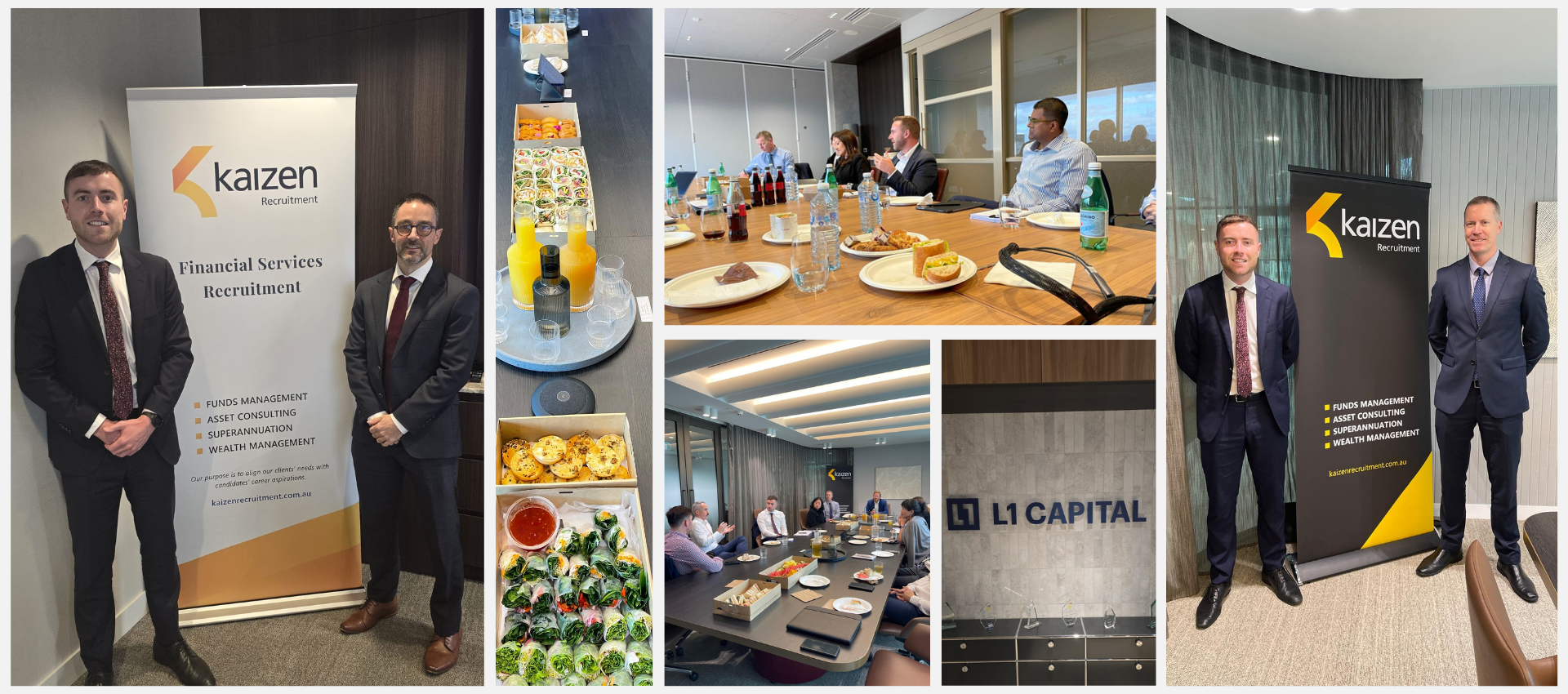
 We’d like to extend our sincere thanks to the leaders who participated, representing ROC Partners, MA Financial, Ellerston Capital, Macquarie Asset Management, Centuria Bass Credit, AMP, and Koda Capital. Special thanks to Greig Nicholson for moderating the session, and to ROC Partners for generously hosting us in their boardroom for what proved to be an engaging and insightful luncheon.
We’d also like to extend our sincere thanks to the leaders who participated, representing IFM Investors, Generation Life, L1 Capital, Centuria Bass Credit, Neuberger Berman, VFMC, Qualitas, Equity Trustees, Bell Asset Management, Bennelong, and Cooper Investors.
We have long recognised a gap in the consistent sharing of knowledge between leaders in investment management. This roundtable was designed to support those leaders by facilitating candid conversations, the exchange of ideas, and actionable insights.
Key Themes and Discussions
1. The Practical Adoption of AI in Investment Operations
One of the most discussed topics was the evolving adoption of AI. The consensus: while AI holds immense promise, implementation is still in its early stages for many organisations. So far, AI is being used in specific operational functions, such as:
• Reconciliations
• Operational due diligence forms
• Report generation
• Member reporting and engagement
While some funds referenced modest ROI — such as FTE reductions through automation — most agreed that AI’s value lies in enabling scalability to meet growing investor demand for customised and timely reporting.
The prevailing view? AI won't replace people — but it will replace people who don't learn to work with AI.
Participants also noted that while many system vendors are integrating AI features, there is a divergence between promise and performance. Many remain unconvinced of the tangible value added so far.
Data: The Fuel Behind AI
As expected, data quality and accessibility dominated much of the conversation. Most funds have built data warehouses, yet still find themselves constrained by legacy or bespoke systems that limit integration and insights.
“Good data in, good data out” was a recurring theme — underscoring that AI’s effectiveness hinges on high-quality inputs.
Bottom-Up Energy vs. Top-Down Caution
This does continue to create tension between innovation and risk. Younger team members are enthusiastically experimenting with AI tools to increase efficiency and output, but many organisations remain “cautious followers”, and AI adoption remains in its infancy across much of the industry. Privacy concerns and the need for data governance have led to the introduction of AI policies and frameworks, but the challenge remains: how to strike the right balance between control and innovation.
2. Technology as a Competitive Advantage
When the conversation shifted to systems and technology, leaders discussed how they are leveraging technology to drive operational efficiency and strategic value. This was particularly challenging for private markets fund managers, who cited difficulty in finding systems that serve both operational and finance teams effectively.
3. Regulation and Industry Standards
The recent ASIC discussion paper on private markets was also raised. Leaders from private market firms welcomed the attention, viewing it as a step towards higher standards and transparency across the sector.
4. Custodians: Standardised Service, Rising Risk Aversion
Participants noted a trend among custodians towards increased risk aversion, with a reduced willingness to offer bespoke services to clients. This one-size-fits-all approach is creating friction for funds with more complex needs and has led some operations teams to consider alternative service models.
5. Beyond the Cost Centre: Strategic Value of Operations
A key theme of the roundtable was the shifting perception of investment operations. While traditionally seen as a cost centre — often only noticed when things go wrong — many leaders are actively repositioning their teams as strategic contributors to business outcomes. The conversation highlighted how operations professionals are adding value through innovation, risk mitigation, and cross-functional collaboration.
6. Market Data Costs Under Scrutiny
Market data fees continue to come under pressure, with operations teams often tasked with overseeing and optimising these costs. The group discussed strategies to improve cost transparency, consolidate usage, and ensure value for money — a growing priority as budgets tighten.
Talent Trends: Skills, Offshoring, and Hiring for Attitude
As a recruitment-led roundtable, it was only natural the conversation turned to talent. Leaders shared reflections on their own career paths — many having gained broad exposure early in their careers, opportunities that are now rarer due to increased offshoring.
When it comes to hiring, there was strong alignment across the group:
Attitude trumps technical skills — you can train the latter, not the former. Candidates with lateral skills, such as data analytics, are increasingly valued. There is a supply-demand gap, especially in private markets talent. Flexibility is key — the “unicorn candidate” is rare.
1. Operating Models Under Pressure
With tighter fiscal conditions and headcount constraints, most teams are operating with limited capacity. This is particularly impacting the ability to build dedicated data teams or enhance in-house analytics. As a result, many firms are exploring alternative models, including outsourcing and tech-enabled solutions, to lift capability without a significant cost burden.
Most firms now maintain offshore teams in the Philippines, India, or Vietnam to ease local cost pressures. The success of these teams, however, hinges on strong engagement from onshore leaders — including training, coaching, cultural alignment, and recognition.
2. Offshoring: Impact on Junior Talent
The continued trend of offshoring has led to a noticeable decline in junior roles across custodians and fund administration firms in Australia. As a result, many attendees highlighted the growing difficulty in sourcing talent with broad, end-to-end operational experience. Some firms have tackled this by functionalising their teams, and cross-training across operational functions to build depth across teams.
3. Talent Mobility: The Front Office Challenge
An interesting discussion emerged around the career mobility of operations professionals. While many leaders said they proactively support team members seeking front-office progression, they observed that few individuals are willing to make the personal commitment to acquire the technical and behavioural skills needed to make the leap. The desire is often expressed, but the required investment in development remains a barrier.
Final Thoughts
The roundtable reinforced that investment operations teams are at the centre of many of the industry’s most pressing challenges — from AI and data to resourcing and cost control. What was clear is that the future of operations will belong to those who can marry innovation with governance and bring a commercial mindset to problem solving.
We are incredibly grateful to all who joined us at the roundtable. At Kaizen Recruitment, we see it as a privilege to act as a trusted partner and conduit for knowledge-sharing across Australia's investment management sector.
As a multi-award-winning financial services recruitment firm, we are committed to helping clients and candidates navigate industry trends, challenges, and opportunities with confidence. Whether you are looking to hire exceptional talent or seeking your next opportunity, Kaizen Recruitment is here to help.